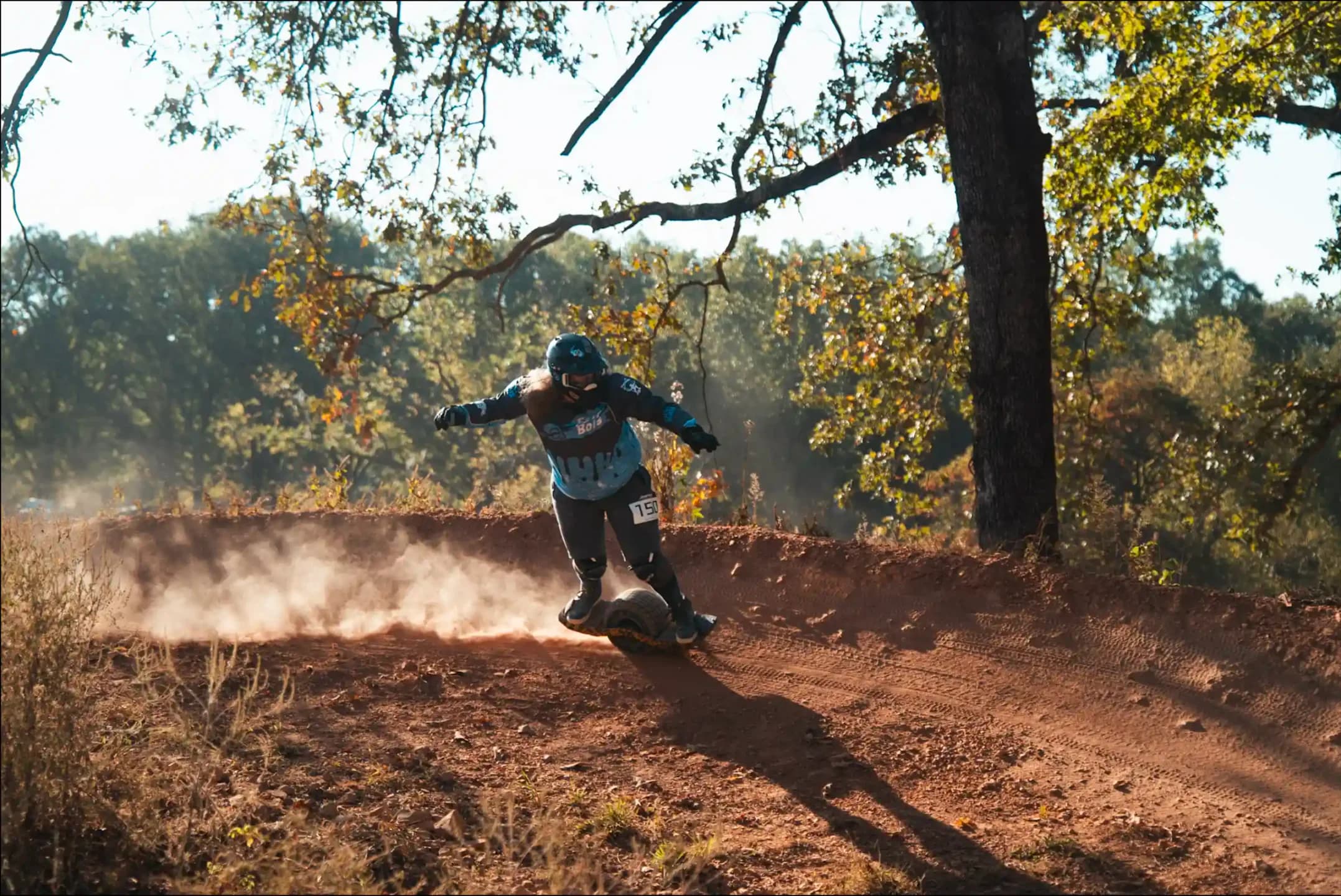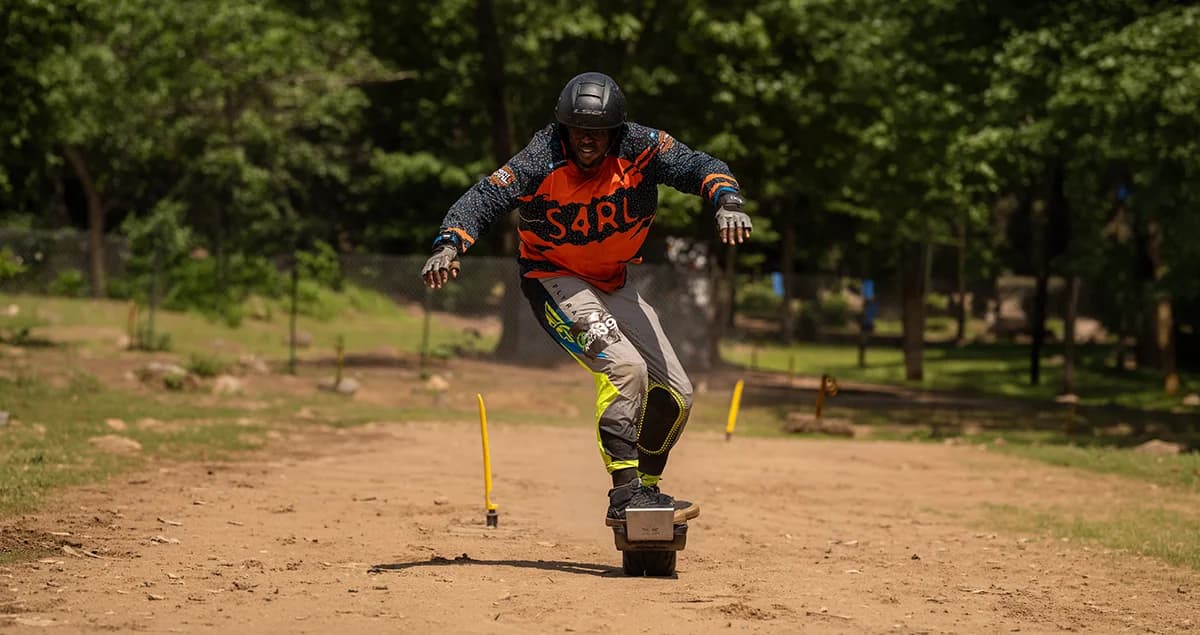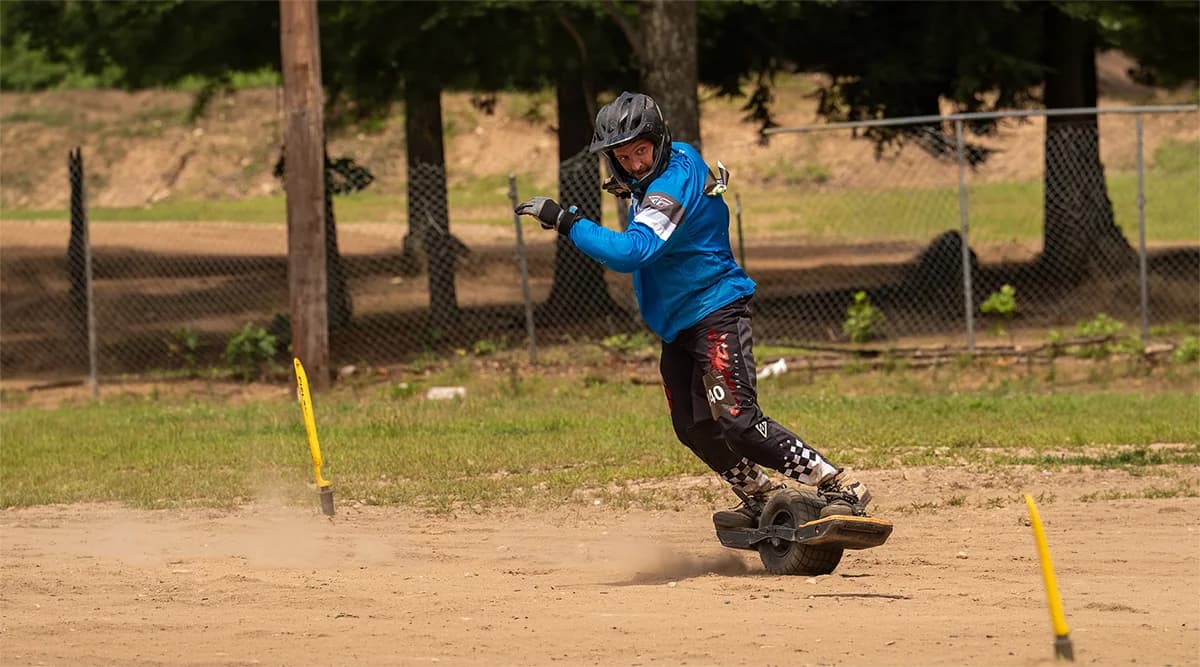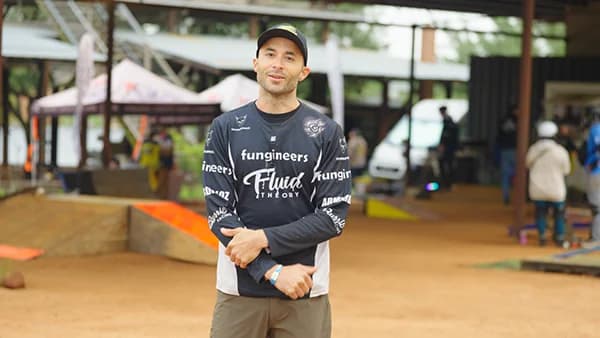
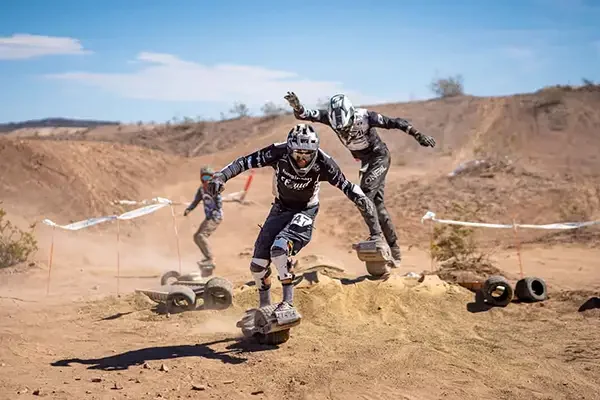
LaCour fighting for first place, which he captured at Let it Ride 5. Photo by @thatsginterev
Branden LaCour was riding a Meepo through Chicago when he started asking himself a question he couldn't shake: what if there was more?
The electric skateboard got him around the city. He joined group rides, used it as his main transportation, learned to drop curbs and throw power slides. But something was missing. "It'd be cool to just kind of do some slides or bigger drops, like some kind of trick, a shove it or something," he recalls. He could feel the ceiling.
Then, on a group ride, he ran into a rider named Andrew Stroh. Stroh was flying through the city with what LaCour can only describe as style and steeze, hitting obstacles, moving with a freedom the Meepo could never offer. "I was like, that. Now that is it."
He got a Onewheel. And he never looked back.
From Chicago to Austin
LaCour picked up his first Onewheel, an XR, right around 2020. The riding came naturally. The racing took longer.
"I was always in like top 10 but like lower top 10," he says. "Throughout the years I just climbed my way up." He discovered trail events while still in Chicago and fell hard for the format. The snowboard feel on singletrack, the technical features, the way speed and finesse had to coexist on a trail that didn't care about either. It lit something up in him.
Eventually he landed in Austin, Texas, and found himself in the right place. The city is big enough to have a real scene but surrounded by enough nature to ride seriously. His go-to is South Walnut Trails, ten minutes from home, a mix of flow and chunky technical terrain that lets him work on both ends of his game. His favorite is Forest Creek Ranch, about thirty minutes south, a custom-built trail system that actively welcomes Onewheel riders.
"They actually understand us and know that we can flatten out the trails and not create divots," he says. "It's got tons of rollers, jumps, features, really good flow." On weekends before a season he puts serious miles on his legs there. Speed work comes through Strava and Hermes laps. At events he stops running full laps and starts dialing individual sections, building the mental map that lets him push at race pace without second-guessing himself mid-line.
That level of preparation reflects something deeper in how LaCour is wired.
The Athlete Underneath
Before the Onewheel, there was the road. LaCour ran competitively for years, grinding toward a sub-six minute mile through sheer repetition when natural ability wasn't going to get him there alone. He played soccer. He trained, and trained, and trained. "I always had to work really hard for whatever I do," he says. "I took that same mindset and put it towards Onewheel."
He's also a rock climber, a software engineer, and at 38, someone who has gotten serious about recovery. He eats to manage inflammation now, something he didn't think about when he was younger and the falls didn't add up the same way. He takes calculated risks on course, thinking through whether a feature is worth clearing before committing. At Let It Ride he watched other riders send the stair set and asked himself honestly if that was his move. He decided on a fast but controlled line instead.
"I'm 38 now so I can't take massive slams and get right back up," he says. "I need to be really smart about my line choices and how I race so that I can push it to my limit and know I'm relatively safe doing so."
The off-season rock climbing is deliberate too. The sport gives him a physical and mental break from Onewheel without pulling him off athletic training entirely. Burnout is real, and LaCour has been around long enough to know what it looks like.
The Breakthrough
For years the podium stayed just out of reach. He was competitive, improving, present at events. But the results didn't reflect what he felt building inside his riding. Then he reached out to Fungineers.
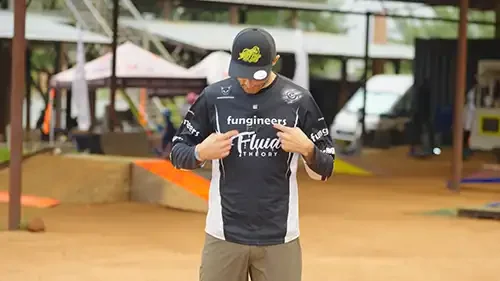
LaCour showing off his sponsors at Lemonade Float Fest x Amped Electric Games. Photo by @eridelife
I knew something was gonna change that year and I was having a hard time getting sponsors to just help because it's really expensive to go to these events
He made his pitch on instinct. He hadn't podiumed yet but he could feel his trajectory. He told them he believed something good was coming and asked if they'd come along for it.
They said yes.
What followed was the best season of his riding life. He won four events: Lemonade Float Fest, two Dirt Surfers events, and the Windman Dual Slalom. He took second at Northwest Electric Fest. The momentum carried into 2026 without missing a beat. He took Men's Pro at Let It Ride before heading to Lemonade, arriving not as someone chasing a podium but as someone defending a standard he had already set.
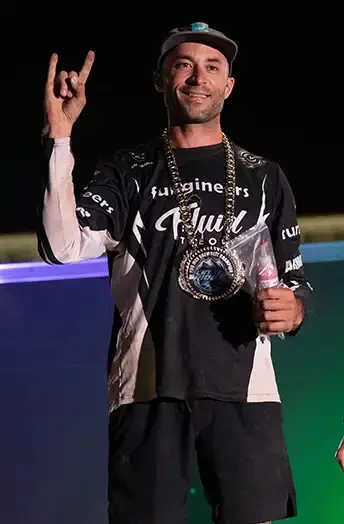
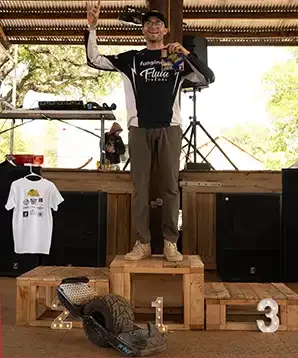
LaCour on the podium at Let It Ride 5. Photo by @eridelife
Results were showing up everywhere, and Fungineers was there through all of it, including sending parts when his equipment broke down mid-season.
It makes me a little emotional thinking about it. They believed in me and then I had the best season of my life.
Fluid Theory out of Philadelphia came on board the same year, equally invested in the person behind the results. Their product, glow kits that light up and customize a Onewheel, reflects a brand built around the culture and aesthetic of floating as much as the performance side of it. For LaCour, who came up chasing style through Chicago streets, that alignment runs deeper than a logo placement."These two companies together just helped me make it happen last year," he says.
This year added Sticky Feet to the mix. At events like Lemonade Float Fest where Texas spring conditions can turn a course muddy and unpredictable, grip matters. "It really helps with all the mud and all the stuff that's going on," LaCour notes. It's the kind of practical edge that doesn't show up in highlight reels but makes a real difference when the course gets difficult.
What Keeps Him Coming Back
LaCour took a year off in 2023. He thought hard about whether the time and money and physical toll were worth it. He talked to his girlfriend about it. He talked to himself about it.
He came back.
"There's always this pull inside me that I feel like I just belong," he says. "I just love pushing myself on it. Even if I don't win, I enjoy getting in that flow state that you can only get when you're in competition where everything's on the line."
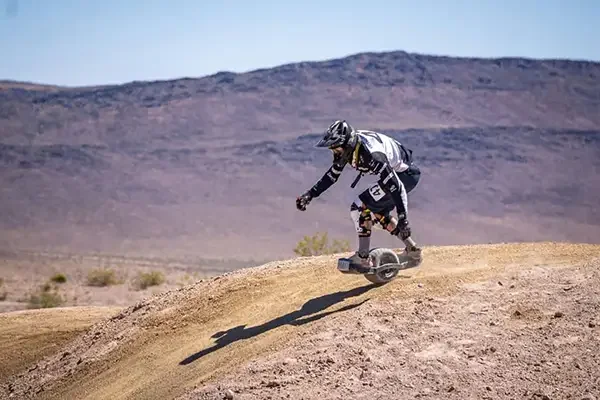
LaCour dropping into "The Monstah" at Let It Ride 5. Photo by @thatsginterev
He's also shifted how he approaches events. Early in his competitive career he would arrive focused to the point of isolation, training hard and keeping to himself. He didn't enjoy it as much. Now he shows up socially, stops to help other riders dial in a line if they're working something out, stays present in the community that surrounds the racing. "What is life if you're not part of the community and you're just focusing on yourself the whole time," he says.
His favorite moment at an event like Lemonade isn't the race start. It's Saturday night. Silent disco, games, the pressure valve releasing after competition is done. "I get to finally relax and chill," he says. "The stress and nerves kind of relax after racing."
Looking Ahead
LaCour won the first two events of the 2026 season and shows no signs of leveling off. He's thought about where the sport goes next and the vision is ambitious: bigger features, dirt bike-scale production, the kind of spectacle that pulls in Red Bull and Monster and turns casual observers into fans.
It's getting those bigger companies to see the potential in the sport. It's all about getting spectators involved and enjoying it. Even if they don't ride a Onewheel.
For Branden Lacour, Austin-based rider, software engineer, former endurance runner, rock climber, and now one of the most consistent names on the float racing circuit, the journey from a Chicago group ride to a national podium run was never a straight line. It was a long grind, then a breakthrough, then the realization that the grind was the point all along.
You can follow him on Instagram at @float_ryder and Youtube or view his full USA FLT racer profile.